Cockpit SX Tutorials: Mixers
Mixers Overview
Many R/C models have control surfaces can often perform two functions. For example, 'ailerons' on some models can act both as ailerons and as flaps. When acting as ailerons they move in opposite directions, and when behaving as flaps, they move together.
To enable such tricks, R/C systems use mixers. A mixer is a software 'black box' whose job is to combine the effect of two or more transmitter controls. Mixers are normally set up in the transmitter.
The Cockpit SX has a very simple and transparent way of programming mixers.
Example: Flapperons
Just to recap:
- As you displace the aileron stick, the surfaces move in opposite directions.
- As you displace the flap lever, the surfaces move in the same direction.
In terms of a mixer:
- The Flap and Aileron controls are mixed to the flap servos
Now let's split it into its component parts for the mixers:
- Flap control -> Flap servo
- Aileron control -> Flap servo
It so happens that Multiplex have given the mixer menus names which usually follow the above model of control-servo , but with each part abbreviated.
- So, for flap (Flap control -> Flap servo), you use F-F mixer
- Fo aileron (Aileron control -> Flap servo), you use the AI-F mixer
The system already knows which direction to drive the servos. All you have to do is to program the 'strength' of each mix. In the case of flaperons, you'd set a strong mix on the AI-F mixer, and a weak one on the F-F mixer, in order to get more aileron movement than flap. Simple isn't it?
Adjusting the Mix
The mixer menu is where you adjust the strength of the mix. All the menus work in the same way (with only a couple of exceptions) so once you have learnt one, you've learnt them all.
In the example below, the Spoiler Compensation mixer below shows 40% spoiler stick signal being mixed to the elevator servo.:
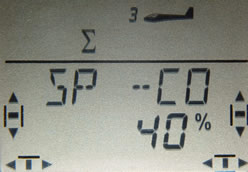
40% Spoiler Compensation
Complete List of Mixers
For a complete list of mixers, see the Mixers section in the Feature Matrix. Note that not all the mixers are available in all model types. However the GLIDER model type is the most versatile - only the DELTA mix and the Y-lead facility are missing.
Specific Applications
Sailplanes with 4 servos in the wing
The Cockpit SX has excellent support for sailplanes with 4-servo wings.
- The servos for the inner control surfaces (flaps) are connected to chs 6 and 7 and controlled by the xx-F (flap) mixers.
- The servos for the outer control surfaces (ailerons) are connected to chs 1 and 5, and controlled by the xx-AI (aileron) mixers.
There are four mixers in each set, supporting crow, snapflap, roll control and camber.
Table 1 - Mixers for wings with four servos
| Mixing Function | Mixer for ailerons (chs 1&5) |
Mixer for flap (chs 6&7) |
Notes |
| crow brakes | SP-AI | SP-F | Ailerons up, flaps down |
| elevator to flap mixing (snapflap) | EL-AI | EL-F | |
| roll control | AI-AI | AI-F | |
| camber adjustment | F-AI | F-F |
Sailplanes with 2 servos in the wing
For sailplanes with two servos in the wing, the control surfaces will normally be designated as ailerons. See the second column above.
Alternatively for some models, it may be better to to designate the surfaces as flaps (chs 6 and 7), see the third column above. See also DLG Setup.
Setting Aileron Differential
Aileron differential is adjusted in the AI-AI (Aileron stick to Aileron servos) and AI-F (Aileron stick to Flap servos) mixers. For more info see differential adjustment.
V-tail and Delta layouts
The VTail and Delta mixers are setup via special menus. Please refer to the manual.