
Electric Mini Ellipse
Electrifying a Classic
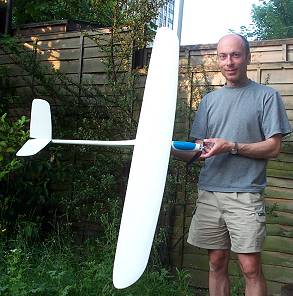
I'm a great fan of the original glider version of the Mini Ellipse, so when I decided to have a dabble at electric, a Mini Ellipse conversion seemed the obvious choice. Before I go further, I should say I am not electrics enthusiast or expert - the purpose of the exercise was to have something to fly during the Foot and Mouth crisis.
Components
Fuselage
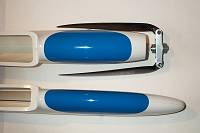 As I already had the wings, this was the only component I needed to buy.
The electric fuse is similar to the glider version in construction and layup (see photo left) but wider. It is very light indeed. The forward bulkhead is marked for various bolt configurations.
Wings
I used the wings from the glider version.
Power Train
On my trip to Dortmund, my friendly e-expert Malcolm Corbin helped me select the following:
- Hacker B20/18L motor (brushless, with built-in 4:1 gear box)
- Aeronaut hub and adapter
- Kontronic Smile ESC (Electronic Speed Controller)
- 12x8 carbon prop.
Two battery packs were used:
- 8-cell Sanyo 600 AE pack (end-soldered, 3x3x2).
- 8-cell Sanyo 700 AR's (braid, 4x4).
Assembly
Power system
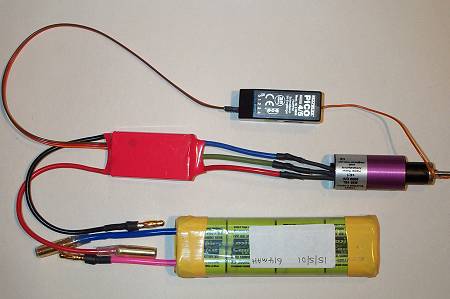 I soldered the motor power cables from the ESC directly to the motor. The order of the connections doesn't matter as reverse rotation can be programmed in the ESC if necessary. Clever these ESC thingies.
Input to the ESC is the Rx Throttle output which also provides power to the Rx using a BEC.
Heavy duty silicon cables were used from the battery, terminating in 4mm connectors. The connectors also serve as the power switch.
Motor
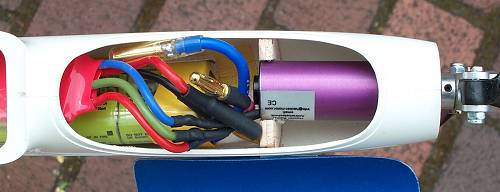
The gearbox was bolted to a false bulkhead using countersunk 2mm bolts. The rear of the motor is supported using 1/4" balsa.
Radio
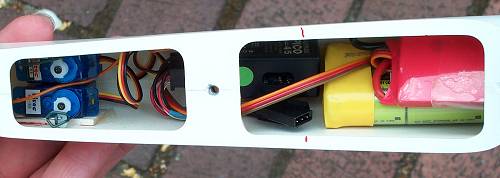
Two Hitec 85 MG's are used for the ailerons. I decided on separate rudder and elevator functions, so two Hitec 55's were installed in the fuselage as (there wasn't enough room for two 85's). Although the servos are tiny, they are quite fast for their size..
The batteries are secured using velcro. The 600 pack fits easily through the canopy. The 700 AR pack just fits but it's very tight! (Photos above and below show 600AE pack).
Setting Up
R/C
The model was set up with aileron, rudder, elevator and throttle controls on my mc4000. Butterfly and V-Tail mixers were used.
Two timers measure total flight time, and cumulative motor run. The latter is triggered when the throttle stick goes beyond 1/4 throttle. Most of my flying is either with the motor either at full power or off, so the timer provides a fairly accurate guide to full-power duration.
Cooling Considerations
Since the Hacker's magnets can destroy themselves above 110� C, I was concerned about cooling. To play safe I slipped the canopy back about 1/2" to provide an air gap - not very pretty! I've found that Farnell sell temperature sensitive dots which change colour permanently according to maximum temperature - potentially useful here.
Weights
Here's a breakdown:
| Component | Weight (gm) |
| Fuselage (inc radio, motor) | 290 |
| Wing (inc. servos) | 302 |
| Battery pack 600 | 158 |
| TOTAL | 750 |
| Battery pack 700 | 250 |
Flight Tests
Performance
Rate of climb is pretty good. We're not talking ballistic vertical climbs, but it's still impressive. How that tiny motor does it I don't know.
Duration
The 600 AE cells give around 2.75 minutes under power. The 700 AR's give 3.5 minutes. I prefer the 600's. They are lighter and the flight duration is sufficient. On a reasonably thermic day I get around 20 minutes per flight, using a combination of short (~15 second) full-power bursts followed by thermal seeking.
Handling
Handling characteristics were a little disappointing after the glider version. I wasn't prepared for quite such a deterioration in glide performance. The model must be flown fast and wide in turns, otherwise the sink rate increases rapidly.
Summary
In its present state, my electric Mini Ellipse falls between two stools - not particularly fast/aerobatic, and not as efficient as I'd hoped as a pure soarer. If anything it tends to the former but it really needs more power - not a shortcoming of the model but more a comment on my choice of motor/battery.
The main thing is that it's fulfilled its purpose as a stopgap measure before soaring resumes, experiments will be resumed later.